
Tight hips from sitting all day: why it happens and what helps
Tight hips from sitting all day usually come from hip flexors held short for hours. Why it happens, gentle desk-side stretches and when to see a physio.
Tight hips from sitting all day usually come from the hip flexors, the muscles across the front of the hip, spending hours in a shortened position while the muscles of your backside barely work. What helps most is standing up more often, plus a couple of gentle stretches that take the front of the hip the other way.
The stiffness is common and usually harmless. The everyday kind loosens within a few minutes of walking around, and that is the useful test: hip pain that doesn't ease with movement is a reason to see a professional rather than do another lunge.
Why do your hips feel tight after sitting?
When you sit, your hips bend to roughly a right angle and stay there. The muscles that bend the hip, the hip flexors, run down the front of it. The biggest is the iliopsoas, which starts on the lower spine and the inside of the pelvis and attaches near the top of the thigh bone. Another, the rectus femoris, is part of the quadriceps and crosses both the hip and the knee.
In a chair, those muscles rest in a shortened, slack position for hours. Meanwhile the glutes, the big muscles you are sitting on, have almost nothing to do. When you finally stand, the front of the hip has to lengthen again and the glutes have to switch back on, and that first minute often feels creaky: a pull in the crease at the front of the hip, a few stiff steps, sometimes an ache in the lower back.
A few things make it more noticeable:
- Long unbroken sits. Two hours without getting up feel very different from two hours with a short walk in the middle.
- A low chair or a sofa. Sitting with your knees higher than your hips bends the hips further. Working from the couch has fixes if that is where your laptop lives.
- One leg tucked under you, or the same leg always crossed on top, which is comfortable at the time and tends to leave one side stiffer.
- Little movement outside work. If the commute, the evening and the weekend are also seated, the hips rarely go through their full range.
Does sitting really shorten your hip flexors?
You will often read that sitting "shortens" the hip flexors. The evidence that office sitting causes lasting structural shortening is thinner than the claim suggests. What is clearer is simpler: muscles and joints kept in one position for hours feel stiff when you move them, and the body tends to get comfortable with the positions you use most and less comfortable with the ones you rarely use.
Either way, the advice is the same. Spend less time in one long sit, and regularly take your hips the other way, into extension, the direction a chair never asks for.
Gentle hip stretches you can do beside your desk
Go to a mild pull and stay there. No bouncing, no forcing, and keep breathing. Stop if anything pinches or hurts sharply, or if tingling or numbness runs down a leg. Use the desk or a wall for balance, and don't lean on a chair with wheels.
Standing hip flexor stretch
- Stand side-on to your desk and rest one hand on it.
- Step your right foot back about a stride, both feet pointing forward, back heel lifted.
- Bend both knees slightly and gently tuck your tailbone under, as if lifting the front of your belt toward your ribs. Squeeze your right glute.
- You should feel a stretch at the front of the right hip. Hold for 20 to 30 seconds, then switch sides.
The tuck is what makes this work. Leaning forward or arching your lower back takes the stretch away from the hip and puts it into your back instead.
Half-kneeling hip flexor stretch
The same stretch, a little deeper, if you can get down to the floor. Kneel on your right knee with a cushion or a folded jacket under it, left foot flat in front, both knees at about right angles. Tuck the pelvis as above and shift your weight forward an inch or two. Hold for 20 to 30 seconds and switch. Raising the arm on the kneeling side overhead adds a little more.
Standing quad stretch
Holding the desk, bend your right knee and take hold of your right ankle behind you, or loop a belt around it if you can't reach. Keep your knees side by side and your pelvis tucked, and you will feel it along the front of the thigh and up into the hip. Hold for 20 to 30 seconds. Skip it if it bothers your knee.
Seated figure four
The other stretches work the front of the hip. This one reaches the back and outside, which stiffens with sitting too. Perch toward the front of the seat, cross your right ankle over your left knee so your legs make a 4, and let the right knee fall open. Keeping your back long, tip your chest forward a little until the right buttock and outer hip feel the pull. Stay there for 20 to 30 seconds, then change legs.
Glute squeezes and bridges
Stretching the front helps more when the back is doing its share. At the desk, squeeze your glutes for five seconds and release, ten times. On the floor at home, a glute bridge does more: lie on your back with knees bent and feet flat, push through your heels to lift your hips until your body makes a straight line from shoulders to knees, hold for a couple of seconds and lower slowly. Ten is plenty.
How long should you hold a hip flexor stretch?
Most general advice is to hold a stretch for about 20 to 30 seconds and repeat it two or three times a side. For desk stiffness, several short sessions through the day are usually more useful than one long session in the evening, because the stiffness builds back up while you sit.
| When | What | Time |
|---|---|---|
| Each time you stand up | Standing hip flexor stretch, both sides | About a minute |
| Mid-morning and mid-afternoon | Hip flexor, quad and figure four | Two to three minutes |
| Evening, a few days a week | Half-kneeling stretch and bridges | About five minutes |
Standing up more often is the real fix
No stretch makes up for a whole day in one position. The most useful habit for tight hips is to break up the sitting about once an hour, even for two minutes. Walk to refill your water, take a phone call standing, or do the standing hip flexor stretch while a file exports. How often should you get up from your desk has a rhythm that fits a real working day, and if the stiffness reaches your back as well, desk stretches for your lower back pairs well with this post.
The way you sit matters a little too:
- Hips level with your knees or slightly above them. Raise the chair if you sink into it, and add a footrest if your feet then leave the floor.
- Feet flat, legs uncrossed most of the time. Crossing is fine for a while. Swap sides, and don't spend the whole afternoon that way.
- A standing desk in spells, if you have one, rather than standing all day. A short walk does more for the hips than standing still.
When hip stiffness needs a professional
Stiffness that eases within a few minutes of walking is the everyday kind. Get it checked by a physiotherapist or a doctor if:
- the pain is deep in the groin, or the hip clicks, catches or locks,
- it hurts at night or at rest, or stiffness lasts a long time each morning,
- the pain travels down the leg, or comes with numbness, tingling or weakness,
- you are limping, or it has been getting steadily worse over weeks,
- it started after a fall or an injury.
Hip pain with a fever, or a hip you suddenly can't put weight on, needs medical attention the same day. A physiotherapist can also tell you whether the hip is the real source, since lower back problems can show up as pain around the hip, and the stretches that suit one don't always suit the other.
A nudge to sit well and get up
Tight hips are mostly a timing problem: you know to get up, you just don't notice the hour going. Notchpals hands that timing to a crew of characters tucked into the notch, and two of its areas split the job between them.
Posture deals with how you sit. Matsu, a three-hundred-year-old bonsai with excellent advice, is one of the Posture characters, and its checks suit a hip-friendly seat well:
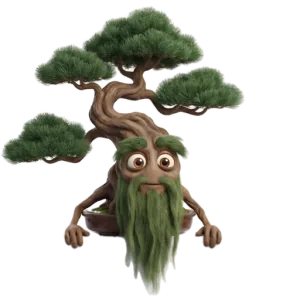
MatsuFeet flat on the floor. Roots first. Then the rest of you may rise.
Movement deals with getting up. Nick, Coach Flex and Bizzy are among its characters, and their Stand up visit comes once you've put in close to an hour at the Mac without a pause. Time away from the keyboard doesn't count toward it. During setup, Blip always takes Eyes and you choose two more areas, so Posture and Movement make a sensible pair if your hips complain, and you can change the crew later in Settings > Crew. When the visit comes, stand, do the hip flexor stretch, then press Done. Notchpals can't tell whether you actually stood, so it takes your word for it.
More on posture
 PostureUpper back pain from desk work: why it aches and what helpsUpper back pain from desk work, the ache between the shoulder blades, often comes from a rounded posture and a low screen. Fixes, stretches, warning signs.
 PostureDesk setup for a Mac: chair, keyboard and screen, step by stepSet up a desk for working at a Mac in the right order: chair and feet, back support, keyboard, mouse, screen height and distance, then light. With a checklist.
 PostureDo posture reminders work? What helps and what gets ignoredPosture reminders can help, but not by holding you in one perfect pose. Why the best posture is your next one, and what makes a reminder worth answering.