
Do posture correctors work? What a brace can and can't do
Do posture correctors work? A brace or buzzer can remind you to sit up while you wear it, but it won't build strength. What helps more at a desk, and why.
Posture correctors work as a reminder, and not much more. A brace that pulls your shoulders back, or a wearable that buzzes when you slouch, makes you notice how you are sitting while it is on, but there is little good evidence that either one changes your posture once it comes off, or that it prevents back or neck pain.
What tends to help more is less exciting: changing position often, a desk that doesn't pull you into a hunch, and some strength in the muscles that hold you up. One note first: if a doctor or physiotherapist has prescribed a brace for you, for scoliosis or after an injury, follow their advice. This post is about the ones sold for everyday slouching.
The two kinds of posture corrector
Most products sold as posture correctors fall into one of two groups.
Braces and straps
The most common design is a figure-eight strap that loops around both shoulders and crosses between the shoulder blades. Longer vests add a panel or stays down the back. Either way, the brace pulls your shoulders back and makes rounding forward uncomfortable. Put one on and you feel taller at once, which is a large part of the appeal.
Wearable sensors
These are small devices that stick to your upper back or clip to your clothes. They sense the angle of your upper body and vibrate when you have leaned forward past a set point for a while, and many pair with a phone app that shows how your day went. They don't hold you in place at all. They only tell you.
Both kinds run on the same idea: feedback. A brace gives it through pressure, a sensor through a buzz.
What a posture corrector can do
The honest case for them is real, just narrower than the packaging suggests.
- Make you notice. Most slouching happens while you are absorbed in something else. A strap pressing on your shoulders, or a buzz between them, brings your position to your attention. Some people find that a few weeks of feedback teaches them to catch their own slump.
- Show you what upright feels like. If you are not sure what "sit up" is supposed to mean, a brace gives you a clear physical example.
- Feel good for a while. Some people say a brace eases a tired upper back in the short term. That comfort is real, but it comes from the brace doing the holding.
What it can't do
The limits matter more, because they are where most of the disappointment comes from.
- Build strength. A brace does the holding for you, so it isn't training the muscles that would otherwise do that job. Strength comes from using those muscles, not from being held in place.
- Keep you moving. Physiotherapists often say the best posture is your next one: no single position is right for hours, and stiffness tends to come from staying still in any shape, good or bad. A brace holds one shape all day, which is close to the opposite of that advice.
- Fix the cause. If your screen is too low, you will lean toward it whatever you wear. Getting the top of the screen near eye level, as in how high your monitor should be, removes the reason you were slumping.
- Reliably prevent pain. Research has had a hard time finding a strong, simple link between everyday sitting posture and back or neck pain. Plenty of people sit in ways a textbook would frown at and have no trouble, and things like stress, sleep and long spells without moving seem to matter too.
Is it bad to wear a posture corrector all day?
Wearing one for part of the day is unlikely to do harm for most people. Wearing one for every working hour has a few downsides worth knowing.
- Rubbing and pressure. Straps that run under the arms can chafe, dig in and get hot. If a brace ever leaves your arm or hand tingling or numb, take it off, and if the feeling doesn't go away, see a doctor.
- Restriction. A tight vest can make deep breaths or reaching across the desk feel awkward.
- Leaning on it. Some physiotherapists worry that long hours in a brace let your own muscles do less of the work. This hasn't been well studied, and there is no clear benefit to wearing one all day to set against it.
- Holding still. The longer you wear it, the more of your day you spend in one fixed position.
If you want to try one, follow the maker's instructions on how long to wear it, start with short spells, and treat it as a reminder for part of the day rather than a frame to hang in. Stop if it hurts.
Do posture sensors work better than braces?
A buzzing sensor avoids the biggest problem with a brace, because it doesn't hold you. You still have to do the sitting up yourself, which is closer to building a habit. The trouble is the buzz itself.
- It goes off at the wrong moments. Leaning in to read a small detail, reaching for a mug or looking at a phone on the desk can all count as a slouch.
- You get used to it. Feedback you get dozens of times a day turns into background noise, and many people end up ignoring it or leaving the device in a drawer.
- It judges an angle, not time. A sensor cares whether you are leaning forward, but what tends to leave people stiff is not moving for a long stretch, upright or not.
If yours lets you set a delay before it buzzes, make it long enough that a brief lean doesn't count, and pay most attention to the buzz that says you have been hunched for a while.
What helps more than a brace
Only one of these needs any equipment, a resistance band, and all of them work on the causes instead of the symptom.
Move often
Change position through the day: sit back, sit forward, stand up between tasks, walk to the window. Getting out of the chair about once an hour is a common rule of thumb. Do posture reminders work goes into why a nudge to move tends to beat a nudge to hold still.
Fix the desk
A screen at eye level, a chair that supports your lower back, and a keyboard at elbow height take away most of the reasons you were rounding forward in the first place.
Build some upper back strength
A few gentle movements, done most days, ask the muscles a brace would replace to do their own work.
- Shoulder blade squeeze. Sit tall, squeeze your shoulder blades gently together and a little down, hold for a few seconds, then let go. Repeat a few times.
- Band row. Loop a resistance band around something sturdy at chest height, hold the ends, and draw your elbows back past your ribs. Return slowly.
- Doorway stretch. Rest your forearms on either side of a door frame at about shoulder height and step one foot forward until you feel a gentle stretch across the chest.
- Chin tuck. Pull your head straight back over your shoulders, eyes level, so that you briefly have a double chin. Hold, then relax.
Move slowly and stay in a comfortable range. Stop if anything hurts or causes tingling or dizziness. A physiotherapist can give you a program built for your body, which is worth more than any list.
A reminder without a strap
The useful part of a posture corrector is the reminder, and you can have that part without wearing anything. Notchpals swaps the strap for a character: now and then through the day, one slides down from the notch on your Mac and asks for one small change. Barnaby, a butler of great dignity, is one of the Posture characters. Where a sensor would buzz between your shoulder blades, he asks politely:
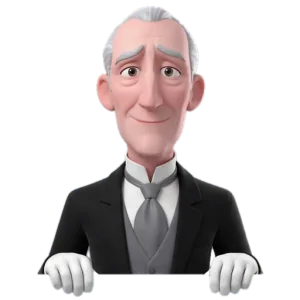
BarnabyShoulders down, if you would. Leave any burdens with me. I'll see to them.
That differs from a sensor in a few ways. Notchpals has no idea how you are sitting: nothing is stuck to your back, and it never looks through the camera. It goes by the time you spend at the Mac and takes your Done on trust. It asks for a change rather than a pose: back against the chair, feet flat, shoulders down, and one afternoon visit about how far you sit from the screen. And since holding still is the other half of the problem, a Movement character in your crew can ask you to stand up after nearly an hour of unbroken time at the Mac.
Pain that lingers, returns, or arrives with numbness or weakness belongs with a physiotherapist or a doctor. They can also tell you whether any kind of support makes sense for you.
More on posture
 PostureDo you need a laptop stand? When it helps and when it doesn'tIf you work on a MacBook at a desk for hours, a laptop stand helps, but only with a keyboard and mouse. When a stack of books will do, and when to skip it.
- PostureErgonomic desk height: how to work it out from your elbowsThe ergonomic desk height puts your keyboard at elbow height with relaxed shoulders. How to measure yours sitting or standing, and fix a desk that won't move.
 PostureHow high should your monitor be? Eye level, tilt and two screensHow high should your monitor be? Top edge at or just below eye level, about an arm's length away. Find your eye line, set the tilt, match two screens.